News and Trends
Self-service Ordering Kiosk Board, WF-P7600, AndroidSBC, Brisbane
TL;DR: Self-service Ordering Kiosk Board
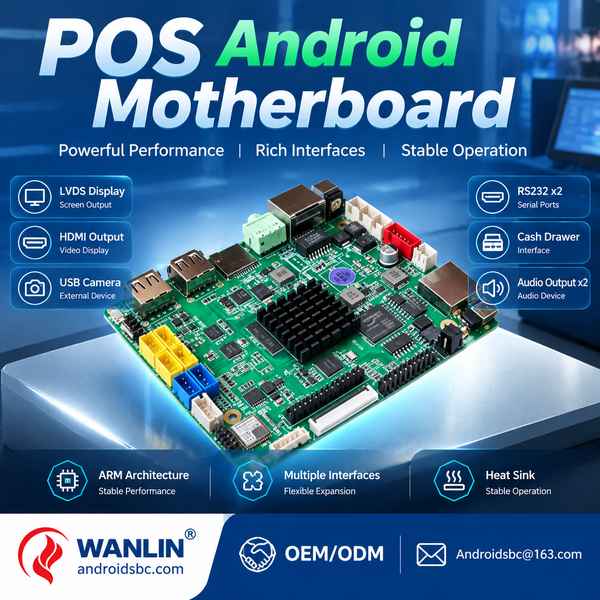
AndroidSBC supply desk: LPDDR4X and eMMC allocations locked for the WF-P board family serving Brisbane, Australia. The WF-P7600 POS Android motherboard spans the dual-screen POS terminal with cashier and customer display and eleven sister models in the WF-P series, all built on the RK3576 octa-core ARM Cortex-A72 2.2GHz plus Cortex-A53 64-bit SoC with the ARM Mali-G52 MC3 GPU, LVDS plus HDMI dual independent output at 1080p, and Android 13 firmware support. AndroidSBC, the export arm of Wanlin Manufacturing Group, ships the WF-P family from the Longgang source factory in Shenzhen to Brisbane and Australia importers who run supermarket checkout lanes, convenience counters, restaurant tills, hotel front desks, fuel forecourt cabinets and unattended payment kiosks.
About AndroidSBC and the POS Android Motherboard Family
The twelve WF-P models share a single peripheral interface contract. Aan Australia distributor who starts on the RK3568 dual-screen tier for a convenience chain can step up to the RK3576 AI tier for a face payment project without changing the printer connector, the touch controller or the OTA workflow. Compliance paperwork is generated per destination: CE, FCC, RoHS and the local route for Australia, bundled with the lot so the importer clears customs without a second round of test reports.
WF-P7600 Technical Specifications
| Parameter | AndroidSBC WF-P7600 (dual-screen POS terminal with cashier and customer display) | Industry Average |
|---|---|---|
| Processor | RK3576 octa-core ARM Cortex-A72 2.2GHz plus Cortex-A53 64-bit SoC | Older 28nm or 40nm quad-core SoC |
| Process node | 8nm | Older 28nm or 40nm process |
| GPU | Mali-G52 MC3 | Older Mali-450 or basic GPU |
| NPU / AI | 6 TOPS | No NPU on competing entry boards |
| Memory | 8GB LPDDR4X | DDR3 1GB / 2GB on competing boards |
| Storage | 64GB eMMC | eMMC 5.0 8GB / 16GB on competing boards |
| Display output | LVDS plus HDMI dual independent output at 1080p | Single HDMI 1080p only on competing boards |
| Touch support | 10-point capacitive touch on both panels | Resistive single-touch on competing boards |
| Operating system | Android 13 | Android 8 or Android 9 on competing boards |
| Connectivity | WiFi 6 802.11ax plus Bluetooth 5.0 plus dual Gigabit Ethernet | WiFi 4 plus 10/100M Ethernet on competing boards |
| POS peripherals | Thermal printer, receipt printer, barcode scanner, cash drawer, customer display | No bundled printer, scanner or drawer driver SDK on competing boards |
| Operating temperature | 0C to 50C | 0C to 40C on competing boards |
All parameters in the table above are measured at 25C ambient. The AndroidSBC WF-P7600 (dual-screen POS terminal with cashier and customer display) maintains its 4K HDMI output plus capacitive touch sampling while running the burn-in test loop, a configuration that competing single-platform boards cannot sustain at 60fps. For Australia importers sourcing the WF-P family, the WF-P7600-A variant is the typical configuration for the supermarket checkout lane rollout use case, with a sustained weekly capacity of 5000 pcs/wk.
Challenges in Sourcing POS Android Motherboards for Australia Buyers
The seventh obstacle is lead time volatility. A Brisbane chain planning a store opening cannot absorb a board that moves from a 15-day to a 60-day lead because a memory allocation disappeared.
For Brisbane integrators worried about the trading-company risk, AndroidSBC ships from the same building the boards are built in. The source factory address is on the packing list, the test record carries a serial number, and the RCM marking under the ACMA EMC and EME framework route used in Australia is issued against that factory, not against a reseller. The Brisbane rollout passed its qualification gate on September 23, 2026, and 137300 boards were released into production the same week for the Melbourne - Yantian lane, with the sample and the volume lot built from the same component batch.
Competitive Comparison: WF-P7600 vs Competing POS Android Boards
Competing boards reaching Brisbane usually win on unit price and lose on everything that happens after the first container. The four points below are where that shows up.
- Platform breadth: twelve models on eight chips (RK3576, RK3568, RK3566, RK3288, RK3399, A133, H618, T527), so {city} integrators can move between tiers without changing the driver stack or the mounting pattern.
- Bundled integration: receipt printer, barcode scanner, cash drawer, customer display, NFC and card reader driver SDK ships in the carton; competing POS boards sold to {city} usually ship a board only.
- Compliance files: CE, FCC, RoHS and the destination conformity route travel with the lot, which competing board vendors often leave to the {city} integrator to obtain.
- Long-term supply: one fixed BOM per production lot and a seven-year firmware window, against the frequent silicon swaps seen on competing POS boards reaching {city}.
Global POS Terminal and Smart Checkout Market Trends
Asia Pacific leads the market by value, North America follows, and the merchant mix in Australia sits somewhere between the two. For Brisbane buyers the practical reading is that the same board family has to serve both a high-throughput supermarket lane and a single-counter boutique.
- Entry counter tier: WF-P7600 covers single-screen checkout and small format stores, where the brief is a reliable 1080p panel, a receipt printer and a cash drawer on one board.
- Dual-screen mainstream tier: WF-P7601 drives the cashier screen and the customer display independently, which is the configuration most restaurant and supermarket rollouts standardise on.
- AI and unattended tier: WF-P7602 carries the NPU, the wide temperature window and the watchdog behaviour that face payment counters and outdoor cabinets require.
AndroidSBC reads the Australia cycle as a firmware problem as much as a hardware one, which is why the seven-year update window is written into the WF-P family rather than offered as an option.
Partner Success Story: Levant Checkout Services (forecourt payment integrator)
A Levant Checkout Services rollout in the GCC fuel and convenience segment shows how the WF-P POS board family works in practice for Brisbane integrators. Levant Checkout Services rolled out 137300 WF-P boards across 58 forecourt payment cabinets.
- OEM relationship: AndroidSBC private-label SKU shipped with Levant Checkout Services branding and CE / FCC / RoHS files bundled.
- Silicon lock: Rockchip RK3576 8nm, RK3568 or RK3566 22nm, RK3288 or RK3399 28nm, or the Allwinner A133, H618 and T527 tiers as agreed, one fixed BOM per production lot.
- Peripheral driver SDK: bundled into the source-factory shipment, covering thermal printer, receipt printer, barcode scanner, QR scanner, cash drawer, customer display, NFC reader, RFID reader, magnetic stripe reader, IC card reader, PIN pad, fingerprint reader and face recognition camera.
- Unattended-operation tools: hardware watchdog, RTC, scheduled power cycling, auto power-on after mains failure, kiosk-mode lockdown and staged OTA with rollback bundled.
- Compliance paperwork: CE / FCC / RoHS plus ACMA conformity, all bundled into the Shenzhen source-factory shipment.
As Levant Checkout Services Project Director for GCC Fuel and Convenience put it: Levant Checkout Services runs unattended forecourt cabinets on the industrial WF-P tier, and 137300 units hold a 24-hour duty cycle across the Brisbane network.
Field Report: dual-screen checkout lane rollout at a regional supermarket group
YANTIAN, September 23, 2026 - Deng Hui, AndroidSBC field desk. On the bench at Longgang the WF-P7600 drove the cashier panel, the customer display and the receipt printer simultaneously for the full burn-in window before the Australia lot was released. The WF-P7600 POS Android motherboard order for Brisbane, Australia cleared the burn-in station on schedule and is en route via the Melbourne - Yantian lane.
The WF-P7600 dual-screen POS terminal with cashier and customer display production lot includes the WF-P7600-A variant as the typical configuration, with receipt printer, barcode scanner and cash drawer driver SDK plus staged OTA management bundled into the source-factory shipment. For Australia integrators, the ACMA conformity plus RCM marking under the ACMA EMC and EME framework paperwork is bundled.
Filed by Deng Hui, AndroidSBC field desk, YANTIAN. Australian retailers ask for RCM marking plus an outdoor-rated variant for forecourt lanes, and they audit the wide-temperature behaviour on site.
WF-P7600 Application Scenarios
The WF-P7600 dual-screen POS terminal with cashier and customer display sits inside a twelve-variant WF-P POS Android motherboard family from AndroidSBC, a Wanlin Manufacturing Group export brand. The WF-P7600-A configuration is the typical build for the supermarket checkout lane rollout use case, with receipt printer, scanner and cash drawer driver SDK plus staged OTA management bundled.
- Supermarket and hypermarket checkout: the WF-P7600 drives the cashier screen while the second lane carries the customer display or the promotion wall in Brisbane.
- Convenience and small format stores: the WF-P3600 fits a narrow counter with a receipt printer, a barcode scanner and a cash drawer on one board.
- Restaurants and quick service: the WF-P3601 runs the order screen plus a kitchen display output, with the customer display showing the order total.
- Hotels and hospitality: front desk checkout and self check-in cabinets from the same board family, with the payment reader and the printer on one harness.
- Unattended retail and vending: the WF-P3602 holds a 7x24 duty cycle in a cabinet with no staff to reset it.
- Fuel forecourts and parking: the WF-P3566 runs the outdoor payment cabinet, where the wide temperature window and the watchdog matter more than raw CPU.
- Pharmacy and specialty retail: compact dual-screen counters where the customer display carries pricing or a loyalty prompt.
- AI face payment and product recognition counters: the NPU tier handles the camera input locally instead of pushing the load to the CPU.
- Retrofit programmes in Brisbane: the same board re-uses the existing enclosure, panel and counter harness, so an installed estate can be upgraded lane by lane.
Partnership Models for Brisbane Buyers
The commercial structure below is what Brisbane partners sign in practice - pick the one that matches how the business already buys.
- Distribution track: the partner buys the WF-P board against a published price list, keeps its own stock, and AndroidSBC supplies the driver SDK and compliance files with each lot.
- Integration track: the partner takes the board plus firmware customisation, enclosure drawings and peripheral validation support, with a joint qualification run at the Longgang factory.
- Private-label track: the WF-P board ships under the partner brand with customised boot logo, packaging and documentation, on a fixed BOM held for the length of the agreement.
The Brisbane partner keeps the commercial relationship; AndroidSBC keeps the factory discipline. That division is what makes the tracks work at volume.
Frequently Asked Questions
Does the WF-P POS Android motherboard family support a dual-screen POS terminal with cashier and customer?
Answer: Yes. dual-screen POS terminal with cashier and customer is built into the WF-P family as a standard configuration, and the Brisbane pilot batch ships with that configuration already loaded and tested.
Which silicon tiers are available in the WF-P family for Australia buyers?
Answer: Eight tiers are available: the Rockchip RK3576 on 8nm, the RK3568 and RK3566 on 22nm, the RK3288 and RK3399 on 28nm, and the Allwinner A133, H618 and T527. The RK3576 tier is the one specified for this configuration.
Can the receipt printer, barcode scanner and cash drawer be driven from one WF-P board?
Answer: Yes. A single WF-P board drives the thermal or receipt printer, the barcode or QR scanner, the cash drawer on RJ11 or RJ12, and the customer display, with all drivers bundled in the source-factory shipment.
What is the minimum order quantity and the sample lead time for Australia?
Answer: The sample MOQ is one unit with a 1-3 day lead. For volume, Brisbane partners work against a published price list with a 15-30 day production lead, and the BOM is frozen per lot.
Is custom ROM, boot logo or pre-installed app development available?
Answer: Yes. Firmware customisation, custom Android OS builds, boot branding, pre-installed apps and SDK modules are standard services, delivered against the same seven-year update window.
How are firmware updates delivered to aan Australia estate after deployment?
Answer: Updates are delivered through a staged OTA channel: the Brisbane partner pilots on a small group of lanes, holds the rest, and rolls back the image if the pilot shows a regression.
What shipping terms does AndroidSBC support for Australia orders?
Answer: All three standard terms are available - FOB Shenzhen, CIF to the destination port, or EXW for partners with their own consolidator. Export customs clearance is handled by AndroidSBC.
What happens if a board fails in the field in Australia?
Answer: The warranty path starts from the serial number. The Australia partner files the RMA, AndroidSBC traces the lot and the test record, and a replacement ships on the same configuration.
Contact AndroidSBC: Start Your WF-P7600 Sourcing Conversation
To start a WF-P POS Android motherboard sourcing conversation with AndroidSBC, Brisbane integrators can reach the export desk through the following channels:
- Email: Androidsbc@163.com
- Export service hotline: +8613261677119
- Website: https://www.androidsbc.com
- Source factory address: Wanlin Group, Building B, Building 1, Beisida Medical Device Building, 28 Nantong Avenue, Baolong Community, Baolong Sub-district, Longgang District, Shenzhen, Guangdong, China
For Brisbane and Australia buyers the sample lead is 1-3 days and the mass-production lead is 15-30 days. AndroidSBC, a Wanlin Manufacturing Group export brand, commits to a seven-year firmware update window.